31 Ekim 2011 Pazartesi

17 Ekim 2011 Pazartesi
Harry Connick Jnr: "Why Would He Call Richard Gere, Not Me?"
“I’m not a movie star. People know me, but they don’t necessarily know what they know me for. I get recognised, but it’s not like Justin Bieber. It’s a nice thing, people are cool.”
And he’s absolutely right. Harry Connick Jnr is just one of those names that’s been around forever, but doesn’t attach itself to any one project. He was the smooth vocal chords on the sountrack of When Harry Met Sally, but he wasn’t in it. He appeared in Independence Day but he’s not Will Smith. Is it because he’s a singer as well, that he defies a category?
“I would say I’m right in the middle,” he decides, when asked to position himself on the singer/actor spectrum. “Because when I’m acting, I’m in a different place, singing is the last thing on my mind, and when I’m on stage, there’s no acting at all involved, not even presentation, it’s just who I am.”
If it’s bugged him that his natural ease in both fields has made him perceived as a jack of all trades, master of none, there’s no sign of it.
“When Chicago came out, I was talking to Harvey Weinstein, and I asked him, “Richard Gere’s a good friend of mine. Why would you call him and not me? That’s what I do!” He started laughing, and he didn’t answer, which is probably that Richard’s a big movie star.
“Perhaps I’ve not been offered movies that I would have been if I didn’t play the piano. I don’t see it, they just don’t call me! I totally get it though. We’ve all been to the movies where we’ve seen a singer on screen, and thought, ‘Great, career move’ and the same with an actor on stage, so I get it, I’m sure there’s some pigeon-holing going on, but I swear on my life it doesn’t affect me, it probably affects those people not hiring me, not me.”
“I just do the things I love to do,” he exclaims, and right now that includes the film Dolphin Tale. Not many people could make a film about children tending to an injured dolphin bearable, but if there are a few people in the world, Harry Connick Jnr is among them, and he is full of enthusiasm for this latest project (co-starring Morgan Freeman, Ashley Judd, Kris Kristofferson), which has enjoyed rapturous reception at the US cinema:
“I didn’t know the story,” Connick relates. “I read the script of what looked like a fun family movie, called up the director, asked him, ‘How did you think of this?’ Turns out it’s a real story, I was kind of embarrassed that I didn’t know about it. When I found out it was true, I thought I had to be part of it.
Dolphin Tale relates how Winter lost her tail but was given another one by the tireless efforts of animal surgeons in Florida, and inspired lots of helpful technology and morale-boosting along the way. The dolphin in the film is played by the very Winter of the true story, and she impressed her cast mates:
“She turned up on time, she knew her lines, she was better than me,” reports Connick. “It was only when I got down to Florida and started working with her, I noticed there was something about her. I think dolphins have their own type of intelligence, which once in a while, crosses with human intelligence, but I don’t claim to know enough about it.”
Connick is also bright enough to avoid the cliché that he’s now any type of reconstructed animal activist after working on such a film.
“No, I think it’s important to choose what you want to fight for very carefully. As a figure of any public recognition, you can water down your effectiveness very easily. Although I feel for the animals there, there are people more knowledgeable and suited to working for that – I choose to spend my time in New Orleans with the musicians there, that’s what I’m an activist for. I wouldn’t be a good representative for other stuff.”
Ahh, New Orleans, the bed of Connick’s Deep Southern easy manners, charm, musical influence and where he spent years perfecting his craft before taking himself off to New York as a young man. He remembers it fondly:
“The whole American Idol way of looking at things is the antithesis of what I grew up with. There are a whole lot of kids wanting to be famous now, whereas if I’d even mentioned that word to one of my teachers, I would have got into a whole load of trouble. We practised and practised, and if opportunity came around, we would have had the skills to be prepared for it. These days, they see the result a lot quicker than they see the process, and that can be a little scary. I think when you’re a kid and you see all of the glory, it may affect your work ethic. Not the kids on this latest film, though, I should stress, they’re hard workers.”
Connick appears to have it all – good looks, talent, pots of money and awards, one of those statistic-defying happy Hollywood marriages and full family life. How does he stay so normal and avoid any diva business?
“My manager told me a long time ago, you can be as famous as you want to be, it’s about the choices you make. I guess I could have been a lot more famous, but I don’t want that. I love my wife, she loves me, so I got really, really lucky in finding a girl that I was compatible with.
“As for any diva business, I’ve got a lot of cousins, a lot of family with my last name and if I came across like that, and none of us were raised like that. My dad was always saying, ‘be on time, be nice to people.’ When I was 18, I was angry all the time, now it’s about getting my kids through school, and helping them. It’s made me a better artist, because it’s allowed me to be in a more peaceful place. I have a big ego, and I’m a confident person, but when it comes down to being a jerk, that doesn’t work for me, I tried it... for about ten years.”
One time Connick was moved to speak out was in Australia, two years ago, when the US star found himself on the judging panel of a variety show, where one of the acts was Jackson Jive – a ‘tribute’ band choosing to glorify their act by blacking up their faces. Connick spoke out against this on the show, and faced a torrent of criticism in the Australian press at the time. Here in London, his ‘people’ are frustrated that he’s asked again about this, but, two years later, it seems the American star still has plenty to say...
“I didn’t say I was offended, I just said I couldn’t be a part of this. Certain markets think they live under a rock, but this is 2011 and when you’re on TV, it goes all around the world, so if there’s a blackface sketch and I’m whooping it up down in Australia, people are at home are going to be ‘are you kidding?’ That’s offensive to America. That was a very specific occurrence. I’m not a civil rights activist, but if something’s going on... They have no idea about American history, but you can’t blame people for not knowing what America went through...”
The publicist in the room is getting anxious now, and Connick apologies for going off on a tangent. No one’s really cross, though, as he grins at everyone with a megawatt smile, and asks, “My bad. Now, who wants to talk about dolphins?”
Dolphin Tale is now showing in UK cinemas.

Joanna Yeates Trial: Vincent Tabak 'Strangled Jo To Stop Screams'

Vincent Tabak claims he strangled Joanna Yeates for 20 seconds after
she screamed when he put his arm around her, a court has been told.Â
Brief extracts from Tabak's defence statement were read out to a jury for the first time as the pathologist who inspected her body was re-examined by the prosecution.
Tabak, who admits manslaughter but denies murder, claims he initially put his hand over her mouth to stop the screams, Nigel Lickley QC told Bristol Crown Court.
The defendant claims to have used "no more than moderate force", Mr Lickley added.
Referring to Tabak's statement, Mr Lickley said: "He removed the hand from the mouth and the screaming continued and then he put the hand around the throat. He believes it was the one from around her back and held it there for about 20 seconds."
In the statement, Tabak claims he "didn't intend death or serious injury", Mr Lickley added.
Mr Lickley asked pathologist Russell Delaney about Tabak's statement that he held Miss Yeates's throat "for about 20 seconds".
Dr Delaney replied: "That period of time would be sufficient to cause the signs of venous obstruction and would be long enough to result in her death."
The statement was referred to after Tabak's QC William Clegg suggested his client used just one hand to strangle her. Dr Delaney said he "cannot exclude the use of one hand" as the claim was made.
Miss Yeates suffered 43 injuries at the hands of Tabak at her flat in Clifton, Bristol, on December 17, Bristol Crown Court has heard.
Brief extracts from Tabak's defence statement were read out to a jury for the first time as the pathologist who inspected her body was re-examined by the prosecution.
Tabak, who admits manslaughter but denies murder, claims he initially put his hand over her mouth to stop the screams, Nigel Lickley QC told Bristol Crown Court.
The defendant claims to have used "no more than moderate force", Mr Lickley added.
Referring to Tabak's statement, Mr Lickley said: "He removed the hand from the mouth and the screaming continued and then he put the hand around the throat. He believes it was the one from around her back and held it there for about 20 seconds."
In the statement, Tabak claims he "didn't intend death or serious injury", Mr Lickley added.
Mr Lickley asked pathologist Russell Delaney about Tabak's statement that he held Miss Yeates's throat "for about 20 seconds".
Dr Delaney replied: "That period of time would be sufficient to cause the signs of venous obstruction and would be long enough to result in her death."
The statement was referred to after Tabak's QC William Clegg suggested his client used just one hand to strangle her. Dr Delaney said he "cannot exclude the use of one hand" as the claim was made.
Miss Yeates suffered 43 injuries at the hands of Tabak at her flat in Clifton, Bristol, on December 17, Bristol Crown Court has heard.
Reports: Investigation To Show Liam Fox 'Breached Ministerial Code Of Conduct'

An official report into former defence secretary Liam Fox's links with his self-styled adviser Adam Werritty is expected to find that he breached the Ministerial Code of Conduct.
The findings of Cabinet Secretary Sir Gus O'Donnell - who was due to deliver his report to David Cameron on Monday night - will be published on Tuesday.
The Guardian reported the country's most senior civil servant will deliver a "damning" verdict on Dr Fox's conduct - while accepting that he had not personally gained financially from his relationship with Mr Werritty.
Dr Fox finally resigned on Friday amid a welter of allegations suggesting his close contacts with his best man and former flatmate breached Whitehall rules.
Sir Gus was last week ordered by the Prime Minister to take over an internal Ministry of Defence inquiry in an effort to provide answers to "all remaining questions".
An interim MoD report has already established that the then defence secretary had met Mr Werritty - who handed out business cards describing himself as Dr Fox's adviser even though he had no official role - 40 times since coming to office.
Their contacts included trips abroad and meetings at the MoD - including talks with the Israeli ambassador, dinner with the new US commander of international forces in Afghanistan, and a meeting in Dubai with a defence supplier without MoD officials present.
Poll Gives Labour Biggest Lead Since 2010 General Election

Labour has opened up its biggest lead over the Conservatives since last year's general election, according to an opinion poll.
The Populus poll for The Times gives the Labour Party an eight-point advantage over the Tories while support for the Liberal Democrats has dropped into single percentage figures.
The poll puts Labour on 41%, three points up on last month, while the Conservatives are down one point on 33%, and the Lib Dems down four to 8% - the lowest levels of support for the two Government parties in a Populus poll since they went into coalition together.
The findings suggest that support for the two parties has been hit by concerns about the economy as well the fallout from the resignation of former defence secretary Liam Fox.
Populus interviewed 1,511 adults aged 18 and over by telephone between October 14 and 16.
The Populus poll for The Times gives the Labour Party an eight-point advantage over the Tories while support for the Liberal Democrats has dropped into single percentage figures.
The poll puts Labour on 41%, three points up on last month, while the Conservatives are down one point on 33%, and the Lib Dems down four to 8% - the lowest levels of support for the two Government parties in a Populus poll since they went into coalition together.
The findings suggest that support for the two parties has been hit by concerns about the economy as well the fallout from the resignation of former defence secretary Liam Fox.
Populus interviewed 1,511 adults aged 18 and over by telephone between October 14 and 16.
Hillsborough Justice Campaign Reaches House Of Commons

The House Of Commons has debated the controversy surrounding the
government's delay in releasing confidential Cabinet papers relating to
the 1989 Hillsborough Stadium disaster.
The debate was watched by many of the relatives of the 96 Liverpool fans crushed to death at Sheffield Wednesday's stadium.
Triggered by a government e-petition that has attracted more than 130,000 signatures since it was set up over the summer, the debate was led by Steve Rotheram, Labour MP for Liverpool Walton.
Rotheram said the Thatcher government at the time of the disaster had briefed against the fans. Describing the alleged briefings as "a convenient excuse to aggregate responsibility," Rotheram then proceeded to read out the names of every person killed in the disaster.
He said he was doing this because the names had never been officially entered into the Parliamentary register before. Around 20 people in the public gallery had travelled to the commons to watch the debate. Many of them were clearly emotional as the names and their ages were slowly read out by Rotheram over the course of five minutes.
"Rest in peace, Justice for the 96," he said before sitting down to unconventional applause from several MPs in the chamber and virtually everyone sitting in the public gallery.
Responding for the government, Home Secretary Theresa may paid tribute to Steve Rotheram, and to the support that people on Merseyside have given to the campaign over more than 20 years. "I will do everything in my power to ensure the families and the public get the truth," she said, promising that no government papers would be withheld from the Hillsborough Panel.
However May didn't give a timescale for the release of the Hillsborough files to the relatives of the victims, saying "It is difficult sensitive and lengthly work and it cannot be rushed."
But the Home Secretary apologised to the families for the way the government had responded to their requests for the files to be released. The government had appealed against a decision by the Information Commissioner to release them earlier this year, creating a common impression that ministers were trying to suppress the files.
The government insists it always planned to release the files to the families, but only once they had gone through the Hillsborough Panel currently investigating all aspects of the disaster.
Theresa May promised that once the files were released - to the relatives first, then the media - there would be "only minimal redaction" to protect junior government officials and the details of family members.
Responding for the Labour front bench, Andy Burnham told MPs that there had been an "orchestrated campaign at Westminster to set the public against the supporters" shortly after the tragedy, which he described as one of the biggest injustices of the 20th century.
He also referred to a story run by The Sun newspaper shortly after Hillsborough, where the paper claimed Liverpool fans had pick-pocketed from the victims - a story the paper has since accepted was untrue.
Andy Burnham suggested that the Hillsborough Panel should consider asking News International to divulge how it came to publish its story, adding that people's views of this story may well have changed in the light of the phone hacking scandal.
MPs are due to debate the Hillsborough files until late on Monday evening, when a motion to release the files is expected to be carried unopposed.
Steve Rotheram MP's speech in the debate can be found on here on the Liverpool Echo website
The debate was watched by many of the relatives of the 96 Liverpool fans crushed to death at Sheffield Wednesday's stadium.
Triggered by a government e-petition that has attracted more than 130,000 signatures since it was set up over the summer, the debate was led by Steve Rotheram, Labour MP for Liverpool Walton.
Rotheram said the Thatcher government at the time of the disaster had briefed against the fans. Describing the alleged briefings as "a convenient excuse to aggregate responsibility," Rotheram then proceeded to read out the names of every person killed in the disaster.
He said he was doing this because the names had never been officially entered into the Parliamentary register before. Around 20 people in the public gallery had travelled to the commons to watch the debate. Many of them were clearly emotional as the names and their ages were slowly read out by Rotheram over the course of five minutes.
"Rest in peace, Justice for the 96," he said before sitting down to unconventional applause from several MPs in the chamber and virtually everyone sitting in the public gallery.
Responding for the government, Home Secretary Theresa may paid tribute to Steve Rotheram, and to the support that people on Merseyside have given to the campaign over more than 20 years. "I will do everything in my power to ensure the families and the public get the truth," she said, promising that no government papers would be withheld from the Hillsborough Panel.
However May didn't give a timescale for the release of the Hillsborough files to the relatives of the victims, saying "It is difficult sensitive and lengthly work and it cannot be rushed."
But the Home Secretary apologised to the families for the way the government had responded to their requests for the files to be released. The government had appealed against a decision by the Information Commissioner to release them earlier this year, creating a common impression that ministers were trying to suppress the files.
The government insists it always planned to release the files to the families, but only once they had gone through the Hillsborough Panel currently investigating all aspects of the disaster.
Theresa May promised that once the files were released - to the relatives first, then the media - there would be "only minimal redaction" to protect junior government officials and the details of family members.
Responding for the Labour front bench, Andy Burnham told MPs that there had been an "orchestrated campaign at Westminster to set the public against the supporters" shortly after the tragedy, which he described as one of the biggest injustices of the 20th century.
He also referred to a story run by The Sun newspaper shortly after Hillsborough, where the paper claimed Liverpool fans had pick-pocketed from the victims - a story the paper has since accepted was untrue.
Andy Burnham suggested that the Hillsborough Panel should consider asking News International to divulge how it came to publish its story, adding that people's views of this story may well have changed in the light of the phone hacking scandal.
MPs are due to debate the Hillsborough files until late on Monday evening, when a motion to release the files is expected to be carried unopposed.
Steve Rotheram MP's speech in the debate can be found on here on the Liverpool Echo website
Energy Bills: Government Says Companies Must Help Customers Save Money

Energy companies must do more to help consumers save money on their bills, the government has said.
Prime Minister David Cameron met the UK’s largest energy suppliers and consumer groups on Monday amid concerns over spiralling gas and electricity costs this winter.
After the meeting Energy Secretary Chris Huhne said that a "substantial" agreement had been reached with the companies, but pulled back from detailing specifics.
"Obviously not everything is agreed," he said. "But I do think we have got a very substantial measure of agreement and we can go forward to this winter with some confidence that we can get people switching more."
The “Big Six” - E.ON, RWE, Centrica, Scottish and Southern Energy, EDF and Iberdrola - are under increasing public pressure over rising consumer prices. With households already squeezed by stagnant incomes and inflation - expected to touch nearly five per cent this week - gas and electricity prices will be a further drain on resources as the weather cools.
Adam Scorer, director of policy at Consumer Focus, said: “I think that whenever you get a time when ... six million households are in poverty, when energy prices have doubled since 2004, that the average energy bill is cracking up to £1,500 it’s not a market issue, it’s not a regulatory issue, it’s a political issue."
Ofgem said last week that the average dual fuel bill in the UK now costs £1,345 per year, with companies making £125 profit per customer.
The regulator said that energy companies have been failing consumers and blocking competition through a combination of complex tariffs, “poor supplier behaviour” and a lack of transparency, and that they need to simplify their price structures. Under the proposals, released on 15 October, consumers who want basic tariffs would get a fixed standing charge set by Ofgem, and standardised formats for price information would allow easier comparison of different suppliers’ rates.
It is this that Scorer said needed to be addressed. “Let’s just hammer down on the way that consumers can save money,” he said. “So paying in the right way - if there’s £200 difference between paying by cheque or by direct debit, let’s tell people that. If you’ve never switched supplier then you’re probably being taken on the highest tariff by an energy company, so let’s tell people that. Let’s tell people what free or heavily discounted insulation is available. So even if it’s only that, for the winter, that’s worthwhile.”
Caroline Flint MP, Labour's shadow energy and climate change secretary, said that the talks offered "cold comfort" to those worrying about paying their bills.
"David Cameron's only response has been to tell the public to wake up and shop around or you've only yourself to blame. This is an insult to people who are worried about paying their bills this winter and shows how out of touch this Tory-led Government is," she said.
Gillian Guy, chief executive of Citizens Advice said ahead of the summit: “This is a huge problem. We’re seeing a rush of people wanting simple, sensible advice about cutting their energy bills. That shows how far the big six have to go in making it easy to get the right deal.”
Calling for a “radical” change from past practices, Ofgem will be releasing detailed proposals to reform the energy market next month, with further regulation to break the “stranglehold of the Big Six” in the wholesale electricity market to follow in December. This is unlikely to be a rapid process, but Ofgem’s proposals last week, followed by today’s meeting, shows that there is some momentum building.
“This [meeting] is about doing probably the only thing that the government can do, which is to strengthen the regulator’s arm and pile the pressure on the companies and say, ‘look, no one believes a word you say. You’re the least trusted sector across the economy. You behave like you’re recently privatised utilities, rather than thrusting, entrepreneurial, competitive companies. You’ve got to change,’ Scorer said.”
A war of words has also developed over the apparent cost of the government’s renewable energy policies. The UK needs to invest around £200 billion to meet its tight emissions reductions targets, and Ofgem said that the cost of government energy efficiency and environmental programmes adds around £100 to the average energy bill.
Supporters say that the long-term cost will be offset by reductions in the country’s dependence on fossil fuel imports, and would mitigate against volatility and future price rises.
Pressure group Friends of the Earth (FOE) said that investments by utilities in gas generation, rather than renewables, was at the root of recent price rises, and called for an enquiry into the big six. By its own calculations, the longer term cost of “dirty” energy would be £300 on consumers’ bills, FOE said.
Others warned that remaining tied to environmental policies could jeopardise the economic recovery.
“The blame game going on around rising energy prices is not helping businesses or households facing very high energy bills. We absolutely need to improve competition in the energy market, but a policy of trying to modify price rises by exhortation is simply not credible. Worse, it hides the very real impact of the expensive renewables programme on energy prices now and, more significantly, over the next decade,” Simon Walker, director general of the Institute of Directors said in a statement ahead of the summit.
“Current policies risk locking us into cleaner and more expensive energy, when the goal should be cleaner and cheaper energy,” he added. “What may have been tolerable in an age of affluence is far less realistic today. Undermining the UK’s competitiveness through high energy costs would do no favours to either economic recovery or the environment.”
Prime Minister David Cameron met the UK’s largest energy suppliers and consumer groups on Monday amid concerns over spiralling gas and electricity costs this winter.
After the meeting Energy Secretary Chris Huhne said that a "substantial" agreement had been reached with the companies, but pulled back from detailing specifics.
"Obviously not everything is agreed," he said. "But I do think we have got a very substantial measure of agreement and we can go forward to this winter with some confidence that we can get people switching more."
The “Big Six” - E.ON, RWE, Centrica, Scottish and Southern Energy, EDF and Iberdrola - are under increasing public pressure over rising consumer prices. With households already squeezed by stagnant incomes and inflation - expected to touch nearly five per cent this week - gas and electricity prices will be a further drain on resources as the weather cools.
Adam Scorer, director of policy at Consumer Focus, said: “I think that whenever you get a time when ... six million households are in poverty, when energy prices have doubled since 2004, that the average energy bill is cracking up to £1,500 it’s not a market issue, it’s not a regulatory issue, it’s a political issue."
Ofgem said last week that the average dual fuel bill in the UK now costs £1,345 per year, with companies making £125 profit per customer.
The regulator said that energy companies have been failing consumers and blocking competition through a combination of complex tariffs, “poor supplier behaviour” and a lack of transparency, and that they need to simplify their price structures. Under the proposals, released on 15 October, consumers who want basic tariffs would get a fixed standing charge set by Ofgem, and standardised formats for price information would allow easier comparison of different suppliers’ rates.
It is this that Scorer said needed to be addressed. “Let’s just hammer down on the way that consumers can save money,” he said. “So paying in the right way - if there’s £200 difference between paying by cheque or by direct debit, let’s tell people that. If you’ve never switched supplier then you’re probably being taken on the highest tariff by an energy company, so let’s tell people that. Let’s tell people what free or heavily discounted insulation is available. So even if it’s only that, for the winter, that’s worthwhile.”
Caroline Flint MP, Labour's shadow energy and climate change secretary, said that the talks offered "cold comfort" to those worrying about paying their bills.
"David Cameron's only response has been to tell the public to wake up and shop around or you've only yourself to blame. This is an insult to people who are worried about paying their bills this winter and shows how out of touch this Tory-led Government is," she said.
Gillian Guy, chief executive of Citizens Advice said ahead of the summit: “This is a huge problem. We’re seeing a rush of people wanting simple, sensible advice about cutting their energy bills. That shows how far the big six have to go in making it easy to get the right deal.”
Calling for a “radical” change from past practices, Ofgem will be releasing detailed proposals to reform the energy market next month, with further regulation to break the “stranglehold of the Big Six” in the wholesale electricity market to follow in December. This is unlikely to be a rapid process, but Ofgem’s proposals last week, followed by today’s meeting, shows that there is some momentum building.
“This [meeting] is about doing probably the only thing that the government can do, which is to strengthen the regulator’s arm and pile the pressure on the companies and say, ‘look, no one believes a word you say. You’re the least trusted sector across the economy. You behave like you’re recently privatised utilities, rather than thrusting, entrepreneurial, competitive companies. You’ve got to change,’ Scorer said.”
A war of words has also developed over the apparent cost of the government’s renewable energy policies. The UK needs to invest around £200 billion to meet its tight emissions reductions targets, and Ofgem said that the cost of government energy efficiency and environmental programmes adds around £100 to the average energy bill.
Supporters say that the long-term cost will be offset by reductions in the country’s dependence on fossil fuel imports, and would mitigate against volatility and future price rises.
Pressure group Friends of the Earth (FOE) said that investments by utilities in gas generation, rather than renewables, was at the root of recent price rises, and called for an enquiry into the big six. By its own calculations, the longer term cost of “dirty” energy would be £300 on consumers’ bills, FOE said.
Others warned that remaining tied to environmental policies could jeopardise the economic recovery.
“The blame game going on around rising energy prices is not helping businesses or households facing very high energy bills. We absolutely need to improve competition in the energy market, but a policy of trying to modify price rises by exhortation is simply not credible. Worse, it hides the very real impact of the expensive renewables programme on energy prices now and, more significantly, over the next decade,” Simon Walker, director general of the Institute of Directors said in a statement ahead of the summit.
“Current policies risk locking us into cleaner and more expensive energy, when the goal should be cleaner and cheaper energy,” he added. “What may have been tolerable in an age of affluence is far less realistic today. Undermining the UK’s competitiveness through high energy costs would do no favours to either economic recovery or the environment.”
Why So Siri-ous?

But wait. Voice technology has been around for a long time. Or, as one TechCrunch commenter succinctly put it on Erick’s video demo post of Siri: “4 year old software, 8 year old technology.” This recalls one of my favorite aspects of tech blogging. You write about something, then everyone and their mother rushes out to yell something along the lines of “OLD!”. Or, even better, competitors trip over themselves to yell “FIRST!”. So if the stuff Siri is doing is old, and if others did do it FIRST, then why is everyone so damn excited about the feature?
There are a few reasons. But the simplest answer is one that has played out time and time again over the past several years: Apple did it right.
No, Apple is not the first to implement voice technology. Nor are they the first to do it on a phone. In fact, Siri isn’t even Apple’s first foray into voice controls. But their first attempt on the iPhone, quite frankly, sucked. It’s no surprise that no one used it. As for Siri, it’s a company that Apple acquired — they were actually doing some of the same things as a stand-alone third-party app previously. Credit Apple for having the vision and foresight to realize that their previous voice control offering wasn’t competitive, and that system-level integration of Siri into iOS could be magical.
What about Google? It’s true that they’ve been far ahead of Apple in the voice control space for years now. I recall being at an event that Google held in August 2010 in which they showed off some new voice functionality for Android. As I wrote at the time, “Google Unveils Awesomely Fast And Accurate Voice Actions For Android“. And that was true. At the time.
But Google failed on a few fronts with this functionality. First of all, while on paper and in staged demos Google’s technology looks great, they failed to make it compelling enough to entice everyday users to use it. They had a pre-defined set of instructions as to what you could say to get the system to work, and they were pretty rigid. By comparison, Apple placed an emphasis on natural language usage with Siri. There are a number of ways to say something to trigger a certain action. You don’t have to remember a set of commands.
Put another way, Google’s voice search and Siri may look comparable on paper. But in reality, one is something best used by a robot, the other is something best used by a human. And robots don’t buy phones — at least not yet.
In the bigger picture, this is something that Apple seems to understand time and time again that their rivals do not. Technology is an ever-important part of everyones’ lives, but the only way to make it truly accessible to the vast majority of users is to humanize it. That’s Siri. Google, Microsoft, etc — they all fail miserably at doing this.
I’m sure in a few weeks, we’re going to see Google come out and say, “wait, but look, we can do all of the stuff Siri can do too!” They’ll tweak their voice recognition to pick up more human phrases, etc. But it won’t matter. They already lost the mindshare battle. Yes, Android had better voice controls first, but if you ask anyone on the street right now which is the phone with the awesome voice controls, they’ll tell you it’s the iPhone.
The funny thing is that while Apple are normally brilliant marketers in this regard, they’re actually holding back on Siri right now. Why? Because they consider the product to still be in “beta”. And while every Google product starts in beta, it’s not a tag Apple takes lightly. Talking with them leading up to the launch, they clearly feel that Siri as it stands right now, while a great first step, is nowhere near where they want it to be. It may take six months to get there. It may take a year. But when Apple does get it to where they feel it’s ready, I bet we’ll see a massive marketing push. And we may even see it come to other devices at that point.
Earlier today, Search Engine Land did a nice side-by-side comparison of Siri versus Google voice actions. Again, on paper, they’re similar, but in reality, they’re far apart right now. But the more interesting aspect of the piece to me was when author Greg Sterling goes against the this-will-kill-Google early reactions and notes that Siri should lead to even more Google searches. I totally agree. For now.
But again, this is a beta product. Does anyone really think Apple isn’t going to work quickly to integrate it with other data partners? Imagine it tied to Quora. Imagine it tied to Twitter (and how is it not already?!). Imagine it tied to Foursquare. Imagine it tied to… Facebook. If and when that happens, Google will have a very legitimate reason to be concerned.
Right now, Google is a middle man between us and information. And we love Google for it. There’s simply too much information out there for anyone to find by themselves. There needs to be a middle man. We need Google. Apple has been hinting for a while that mobile applications could change this game. But apps are just a new, perhaps more accesible wrapper of information. There still needs to be a search mechanism powering the discovery of information — that’s why everyone keeps insisting that Apple will eventually get into the search engine business.
Well they have. But not in the way that everyone was thinking. Siri is their entry point. Again, it’s a small step right now, but it has the potential to be massive. (Perhaps the more pressing question: is Apple okay relying heavily on a third party, Nuance, for what may become a core component of their stack?)
And that’s another fundamental reason why people are so excited by Siri where they aren’t by Google voice search. Google voice search, like basically every Google product, is ultimately a way to drive more Google searches. It’s just a new layer. Even if people don’t fully understand that, they sense that it doesn’t point to something totally new. Siri does point to something totally new. With it, Apple wants to change the information search and creation paradigm. It’s an evolution powered by mobile and a new, more powerful input: voice.
16 Ekim 2011 Pazar
A.J. Hawk Flips Middle Finger: Packers Linebacker Makes Obscene Gesture After Sack
Green Bay Packers inside linebacker A.J. Hawk entered Sunday's game
with just a half a sack to his credit through five games. Having
recorded just a half of a sack all of last season as the Packers won the Super Bowl, Hawk may have thought that he'd already gotten his yearly allotment in the category.
Perhaps that is why Hawk was so very fired up when he sacked St. Louis quarterback Sam Bradford early in the second quarter of the Packers' demolition of the Rams. As part of his sack celebration, Hawk flipped his middle finger at someone. The act was caught by the CBS cameras and will surely earn the six-year veteran a fine.
Seeing as how Hawk was gesturing toward his own sideline it's possible that this finger wasn't flipped in anger. But that distinction probably won't make any difference to NFL Commissioner Roger Goodell.
Perhaps that is why Hawk was so very fired up when he sacked St. Louis quarterback Sam Bradford early in the second quarter of the Packers' demolition of the Rams. As part of his sack celebration, Hawk flipped his middle finger at someone. The act was caught by the CBS cameras and will surely earn the six-year veteran a fine.
Seeing as how Hawk was gesturing toward his own sideline it's possible that this finger wasn't flipped in anger. But that distinction probably won't make any difference to NFL Commissioner Roger Goodell.
15 Ekim 2011 Cumartesi
HTC Amaze 4G review


Hardware
Right out of the box, there's no denying your first impression will be one of shock. The Amaze 4G bucks the 'thinner is better' trend that we've seen the likes of Samsung and its Galaxy S II variants adopt in favor of a large and in charge 5.1 x 2.58-inch design philosophy. Though the handset may not be much thicker than its competitors, at 0.46 inches (11.7mm) thick, its 6.1-ounce (0.17kg) heft certainly gives off the opposite impression. With a similar 4.3-inch qHD super LCD display, the phone picks up right where the Sensation left off, although in this iteration that Gorilla Glass-coated screen spills out of its aluminum confines a tad too much for our tastes. It's an odd design flaw that HTC could have easily remedied by tapering the edges down into the phone's frame, rather than subjecting users to indented palms. Still, as the majority of your usage will most likely have everything to do with data consumption and less to do with carrying on an actual phone call, you'll hardly be bothered by this discomfiting quirk.

One of the first things we noticed when booting up the Amaze 4G was the minute pixelation on its qHD display. It's not terribly obvious, nor is it particularly irksome, but when compared to the similarly super LCD-equipped Droid Incredible 2, this screen is simply dull. Colors on the device appear washed out, and viewing angles take a dramatic hit at 45 degree tilts. It's a far cry from the crisp images and vivid hues achieved by its current competition, the Galaxy S II. And while it would've been nice to see HTC outfit the phone with a Super AMOLED Plus display, we're sure the sheer expanse of the screen will override any of your resolution-centered grousing.
There's no denying it -- the Amaze 4G is a handsome handset. We've seen other past and present high-end smartphones (e.g., the Nexus S and Droid Charge) belie their internals with cheap-feeling, scuff-prone frames, but that's not the case here. HTC's wrapped this HSPA+ present in a unibody mixture of metal and soft touch plastic that not only inspires confidence in the device's durability, but also goes a long way towards justifying its on-contract $260 price tag. Embedded throughout its metallic perimeter are the usual array of inputs and controls. Down at the phone's base, you'll find both a microphone and battery door latch -- the latter of which makes accessing the phone's guts an absolute breeze. Up top, a power button and 3.5mm jack preside, with the volume rocker and dedicated camera buttons over to the right. On the left-hand side, a lone micro-USB port breaks up the device's otherwise unblemished chrome trim.

Nestled between the HTC and T-Mobile branding at the very apex of this 960 x 540 screen is the admittedly underpowered earpiece which houses an embedded notification LED. Flanking it on either side are a front-facing 2 megapixel camera and proximity sensor. Around back, we find a speaker grill directly adjacent to an 8 megapixel shooter with dual LED flash, and lurking below that soft touch back is an NFC chip -- the first for an HTC device, although there isn't much use for it yet. Moving on to the exposed internals, we have the requisite SIM card slot, accompanying 1,730mAh battery and vacant microSD card reader. The handset comes packed with an ample 16GB of onboard storage, but if you're looking to load it up with an abundance of audiovisual goods, you better plan on supplying additional capacity.
Performance and battery life

Let's not beat around the bush, though. In the rush to get this 42Mbps capable device to market a few rough edges were overlooked -- namely, battery life. Consider the Amaze 4G a kind of Thunderbolt redux: both phones unleashed into the market ahead of their time, destined to bear the torch of heretofore unseen speeds (well, for HSPA+, at least) at the heady sacrifice of daily usage. It could be the dual-core architecture or the demands of the "4G" network, but whatever the culprit, expect a good three to four hours of action before hitting a productivity ceiling and plugging back in to your nearest outlet. A three-hour charge should get you back up to 100 percent and running -- until the next three hours, that is.
In our short time with it, we've found the phone will consistently drain from fully juiced to about 30 percent after just three hours of light to moderate use -- that's with Twitter, Google Reader and two email accounts synced. Toss in some casual web browsing, a YouTube video or two and a half an hour GTalk session, and the aforementioned four hour limit is easily reached. Power users should heed this warning and turn a blind eye to the Amaze 4G's tantalizing promise of next-gen wireless wonderment, as the oft-recommended need for an extra battery would here be multiplied by two.
You want benchmarks, you say? Well, we've got 'em by the loads. In the name of a fair fight, we've lined up these various CPU / GPU stress tests against Magenta's own Galaxy S II variant. For Quadrant, Sammy's beastie beat out the Amaze 4G, scoring 2,576 vs. 2,514. Linpack averaged about 51MFLOPS, easily topping the GSII at 42MFLOPS for single thread and, again, yielding 77MFLOPS vs 70MFLOPS in multi scoring. And the benchmark dominance continued on, with our handset's Neocore score inching over the GSII's 57fps at 59fps.

How does all of that translate into real-world performance? Truth be told, you won't even notice the dual-core chipset chugging away beneath that rapidly warming back. In fact, an average consumer coming from a single-core 1GHz device would be hard pressed to spot an appreciable speed boost. The real vim and vigor becomes apparent when running several apps at once, a feat commonly known as multi-tasking. We ran Pandora in the background while responding to emails, running Google Talk and Maps, browsing the web and scouring the New York Times app for the latest on Occupy Wall Street. To HTC's credit, the Amaze 4G stood up to the test and passed with uninterrupted flying colors.
Network speed and call quality
By now, you're most likely wondering what sort of downlink pizzazz is in store if you do choose to claim this phone as your own. Well, in our jaunts around New York City, we've recorded inconsistent HSPA+ network speeds. That's not to say T-Mobile's service around the farther reaches of the Big Apple is spotty. On the contrary, 4G signal strength was surprisingly strong, dropping down to 2G only twice to our knowledge. But when that 15Mbps / 1.7Mbps magic did happen, it was primarily on the outskirts of the city. Within Manhattan's crush of people and buildings, download speeds hovered in the 6Mbps to 8Mbps range, only occasionally topping out at 10Mbps down -- nothing to sneer at, but certainly nothing to applaud either.

If you absolutely insist on using your handset to make (gasp!) phone calls, get set to dig that earpiece and the edges of the screen deep into the side of your head. Even with the volume cranked up to the max, we had a hard time hearing our callers, who sounded distant and muffled. On the upside, loudspeaker performance is quite robust, and should enable you to move freely around while carrying on that gossip fest. Reception, too, was relatively strong and our voices came across crisp and clear on the other end.
Software

Of course, this is the Android show -- 2.3.4, to be exact -- but you wouldn't know if from the Sense 3.0 smothering at play. It appears as if HTC didn't want to load up the Amaze 4G with an accompanying suite of freshly updated software, and instead saddled prospective owners with an outdated version of Gingerbread and its penultimate UX. Perhaps the company needed to reserve the Sense 3.5 fuel for its gimmicky stab at mobile fashion, a.k.a. the Rhyme. No matter, the Amaze 4G's 1GB of RAM and dual-core 1.5GHz Snapdragon S3 CPU handily beat out any further OEM embellishments or flashy plum-colored finishes.
We have to tip our hat to that beefy Qualcomm chip, as not one iota of lag cropped up in our testing. Transitions between Sense's carousel of homescreens were fluid and devoid of hiccups. Web pages on the inbuilt browser rendered swiftly, capably handling the demands of Flash and other various plug-ins. And equally as impressive was pinch-to-zoom, which responded immediately to our touch with nary an instance of checkerboarding.
Unfortunately, it wouldn't be an Android device if it didn't come bogged down with an array of carrier-installed bloatware. For the Amaze 4G, however, the pre-loaded shenanigans don't quite incite frustration the way Verizon's crapware-heavy devices normally would. Here, the operator-inserted apps like 411 & More, Adobe Reader, Lookout Security, More for Me, Polaris Office and Qik Video Chat are arguably useful, though definitely not essential to the experience.
To get a real sense of the newly bestowed powers of 42Mbps HSPA+, you need go no further than T-Mobile TV HD. The app, which offers a mix of live and on demand content, has been around since the introduction of the Samsung Galaxy S 4G, and gets a real jump start from Magenta's new wireless threads. A live MSNBC program played back almost instantly, however the quality of video stretched across the device's 16:9 dimensions was noticeably poor, and undeserving of the HD labeling. As for that on demand content, a full episode of ABC's Happy Endings downloaded in its entirety within seven minutes -- all thanks to T-Mo's zippy (at times) 4G network. Curiously enough, on both the streaming and downloaded video, audio was noticeably out of sync, rendering the couch potato on-the-go viewing experience a trifle annoying.
Camera


No doubt, T-Mobile intends to lure willing customers in with the promise of super network speeds, but the true crown jewel of this HTC flagship device is actually its camera. The Amaze 4G borrows the same backside-illuminated 8 megapixel module found on the myTouch 4G Slide, and unsurprisingly, it performs just as well here. It's clear the company intended this phone to be a replacement for your point-and-shoot, tacking on camera shortcut keys and bundling it with user-friendly photo software. We put the 3.69mm lens and its various scene modes to the test and came away mostly convinced -- this might be all the camera you need. That's not to say we don't have our gripes. While the incessantly autofocusing sensor definitely has it perks, we struggled on more than one occasion to get the focus ring to settle and let us snap a clear shot. Additionally, low light shots, even when taken in Night mode, often resulted in grainy, oversaturated pictures. As for video, recordings made in full 1080p HD came off largely without a hitch, displaying good contrast and sharpness of detail, although we did note an occasional decrease in frame rate from time to time.
Keeping the camera tech fresh for amateur photogs are two new HTC-added features -- SmartShot and PerfectPics. Despite its promise to sample multiple shots and deliver a smile-laden composite photo, SmartShot is essentially a useless and ineffectual mode. After dozens of failed and frustrating attempts, we were only able to procure five successful images, with the rest being a blurry mix of happy / sad faces. As for PerfectPics, well that's less of a mode and more of a smart gallery. Using an algorithm, the software parses through your photo collection and deposits your Avedon-worthy series of still lifes in a separate gallery. It may just be our artistic bias, but we're inclined to believe PerfectPics' critical eye is all a bunch of hooey. Bizarrely enough, many of our least favorite photos made their way into this A.I. curated collection, leaving our vastly superior photos lumped in with the rest.


We have to hand it to HTC on this one: the zero lag shutter and constantly autofocusing f2.2 sensor lend themselves well to fits of sudden photographic inspiration. If you see something that catches your fancy, all it takes is a drop of the camera app into the lockscreen ring and, voila!, you're right there, finger on the shutter, capturing the moment you thought would slip by. This ease of use gradually becomes addictive and, in time, you're likely to take it for granted. As you can see in the galleries above, our tour of Central Park gave way to fleeting moments of filmic brilliance that would otherwise have been lost with a lesser-equipped phone.
Wrap-up

So, does HTC's new flagship manage to live up to our high expectations and its hyperbolically named state of awe? We'll put it this way: a better moniker for this girthy handset would've been the Kind of Awesome 4G. As a daily driver, the Amaze's bound to leave you high and dry a few short hours into your day, critically hampering your busy work / social schedule with its power-hungry demands. Sure, you can obsessively monitor your screen's brightness, manage syncing and hold off on the mobile video consumption until you're close by to an outlet, but the name of this industry game is wireless, and T-Mo's Galaxy S II's already out of the gate. Ignore this phone's battery life shortcomings, and you're left with an elegant camera module and T-Mobile's just out of reach 42Mbps HSPA+ dangling carrot. Simply put, it's just not practical to opt in for a high-end device that will, sporadically, treat you to downlink speeds that are half of what's been promised, and desert you in the process. At the end of the day, the purchase choice is yours to make, but for our money, we'd hold out for something packing a wee bit more milliampere-hours. The Amaze 4G XL with Beats, anybody? It's inevitable, and you know it.
Assange Addresses Occupy London Protesters
The WikiLeaks founder made a surprise appearance as the Occupy Wall Street movement spread to London. Mike Giglio reports.
Julian
Assange, the mercurial founder of WikiLeaks and anarchist
extraordinaire, made a surprise appearance at London’s St. Paul’s
Cathedral today to address crowds of protesters occupying the city’s
financial district.
Outside Paternoster square, along
Ludgate Hill road, a sea of people thronged behind a line of riot cops,
unable to access the heart of the protest. As Assange and his security
detail made its way from the back of the square, through the police
cordon and past the Mark and Spencer’s and Starbucks, cheers erupted
from the crowd—which included members of the hacktivist collective
“Anonymous,” who helped organize the event and who turned up sporting
devilish Guy Fawkes masks. Assange—dressed in his typical attire of a
leather jacket and blue jeans—reached the Cathedral stairs and
protesters thronged before him. “Sit down, sit down!” people cried. The
protesters obediently knelt. “Let Jesus speak!” someone yelled. One of
the protest’s organizers took the microphone and asked for an
open-source vote. “Who wants Julian to speak?” he said. There were
scattered boos, but most people raised their hands in a “yay” sign and
Assange took the microphone. He asked the crowd to do a call and repeat.
“Like
all of you, I have had difficulties getting in here today,” he said.
The crowd dutifully shouted back the words. “But there are many people
who haven’t yet been able to get through.” The crowd, confused, mumbled
half the line in response. Assange told the protesters that they were
part of a movement “from Cairo to London.” He railed about how the law
was being obstructed in Guantanamo Bay and about money laundering in the
Caymen Islands and in London. “This movement is not about the
destruction of law, it is about the construction of law,” Assange said.
“I just wanted to say, we are all individuals.” The crowd cheered. A
girl started tossing candy out at the protesters and Assange stepped in,
grabbed a handful of treats and lobbed them into the crowd. Then, as
mysteriously as he appeared, he was gone.
Before Assange’s arrival, the crowd
had been thinning out as protesters—mostly young and white—seemed
unsure of where to go or what to do. Some milled about with large signs
descrying the banks and financial institutions for imperiling the global
economy. “Here comes the ethical revolution,” one placard read. Others
claimed, “We are the 99 Percent,” “Cameron Must Go,” and “Goldman Sachs
Is The Work Of The Devil.”
At first, the crowd’s plan had been
to march from Paternoster square to The City, the heart of London’s
banking elite, beginning around noon. But police cordoned off the
square, effectively blocking more people from joining the scene and
preventing the crowd from leaving. When the protesters attempted to go
down different side streets, the riot cops effectively contained them.
At one point, the crowd began to get rowdy. “Shame on you,” people
chanted at the cops. The police dogs started barking aggressively. A man
with a loudspeaker yelled, “Let’s go back, let’s go back, give them
space, give them space.” Meanwhile, a young woman on the front-line
screamed, “There’s not enough of us! Move forward!” The crowd eventually
fell silent and lost its momentum to break the police barrier.

Back in the crowd, a young man looked at his friend. “There’s nothing to do here,” he said. “Let’s do something else.”
Meanwhile, Ronan McNern, 36—a
bearded activist working to support the Occupy movement—insisted to a
Newsweek reporter that the protesters did have a plan. When pressed, he
couldn’t give specific details; “but there is a plan.” He said that they
movement was leaderless on purpose. “We need a new movement. That
movement doesn’t know what it is yet, but this is the beginning.” He
pointed out that it was hard to find a place to protest in London
because of the amount of private land in the city. “This is just a
microcosm of the world, the amount of control that’s here.”
As the day waned into a sparkling,
cloudless afternoon, some protesters made plans to camp out in the
square. One woman addressed the crowd from the Cathedral steps: the
protesters needed to start holding collective meetings to figure out how
to get food and find bathrooms. Over at the Starbucks, a steady line of
people were queuing to use the loo. One American woman, in London for
the week on business, was frustrated that the police wouldn’t let her
leave the square. “I’m just trying to meet my friend at the train
station. They won’t let me out,” she said.
“I’ve come, I’ve met my friends,
I’ve learned a couple things. Looks like we’re stuck here for a couple
of hours,” added Alan Mascaporne, a recent university graduate. “Julian
Assange can leave and we can’t? We’ve been here for two, three hours
now,” he said to a friend.
http://www.thedailybeast.com
http://www.thedailybeast.com
The 24 Most Bizzare Injuries in Baseball History
In February 1993, Cleveland Indians’ catcher Sandy Alomar Jr. arrived
at spring training with an aching back aggravated by the drive to
Florida. How could an athlete in his prime get injured behind the wheel?
An athlete who survived the rigors of the catcher position 150 games
per season? Why was a man of means driving in the first place?
A sarcastic and shallow sports columnist (OK, it was me) suggested he must’ve been driving a Yugo. Probably a Yugo with a bumper sticker that mocked the traffic around him: “My other car is a Mercedes.” As I seem to remember, Alomar was not amused. Indignant, he shook his finger in my face while saying, “I don’t drive a Yugo.”
He drove a luxury car. I knew that. The Yugo was a joke. Just not to him. Or even some others. Turns out the Yugo people called him to ask about adjusting his seats.
Alomar’s injury, it turns out, doesn’t even belong on the list of strangest injuries involving former Cleveland Indians, let alone among Major League Baseball players.
1. Outfielder Marty Cordova, who played for the Indians in 2001, missed time with the Orioles the following season because he scorched his face in a tanning bed and was ordered by doctors to avoid direct sunlight. Standing in the sun from February through September apparently didn’t give him the glow he sought.
2. Brian Giles, a free-spirit, blamed his absence from the Indians lineup one year on spider bites.
3. Relief pitcher Ernie Camacho signed autographs for a charity one spring, stopped after 100 or so and made a beeline for the team doctor complaining of pain in his pitching elbow.
4. Earlier this season, Indians’ rookie Jason Kipnis strained his hamstring while stretching to avoid, you know, straining his hamstring.
Those aren’t the only examples of why I owe Alomar an apology all these years later.
Here are 20 more that make getting out of a car with a bad back in February seem perfectly reasonable.
5. Pitcher Jamie Easterly started a new workout regimen at home in Crockett, Texas, back in the mid-1980s. One drill included backwards running. He promptly stepped in a gopher hole and hurt his back.
6. Watching a brawl break out one game, reliever Ted Power leapt to his feet in defense of his teammates and strained a calf muscle.
7. Cubs’ pitcher Ryan Dempster went on the DL with a fractured right big toe suffered while tying to jump the dugout railing to celebrate a Chicago victory.
8. In Atlanta one year, utility infielder Randy Johnson dislocated his thumb putting on his socks and spent six weeks on the disabled list.
 9. Wade Boggs might’ve laughed at that if he didn’t miss a week after straining his back while tying to pull on his cowboy boots.
10. Tough-guy Hall of Fame pitcher Nolan Ryan, famous for hog-tying Robin Ventura when Ventura rushed the mound, was bitten by a very brave coyote.
11. Jose Cardenal missed a game in the 1970s, citing fatigue. His claim: crickets got into his hotel room and kept him awake all night. That was his story. Another one of his stories: In 1974 he missed a game because his eyelid was “stuck open,” preventing him from blinking (but not, apparently, fabricating bogus injuries).
12. Rickey Henderson missed several games one August. The reason: frostbite. Why do I feel the need to add “allegedly”?
13. Atlanta Braves closer Cecil Upshaw missed the entire 1970 season when his ring got caught on an awning as he tried to demonstrate his slam dunk technique.
14. Reliever Greg A. Harris once missed two starts after spending an entire game flicking sunflower seeds at a friend who was sitting nearby. Diagnosis: inflamed elbow.
15 and 16. Pitcher Tom Glavine broke a rib vomiting. How weak! Kevin Mitchell only strained a muscle while vomiting.
17. George Brett broke a toe while running from the kitchen to the TV. Why the rush? To see Bill Buckner hit. I would’ve guessed it was to see Bill Buckner field.
18. Outfielder Moises Alou, who came from a proud baseball family, injured his knee falling off a treadmill, then hurt his knee again a year later running over his son with a bike.
19. Pitcher David Cone got bit by his mother-in-law’s dog. Perhaps on command.
 20. Ken
Griffey Jr. missed a game when his protective cup slipped and pinched a
testicle. (I spent four years in journalism school and three decades as
a sports writer wondering if I’d ever get to write such a sentence)
20. Ken
Griffey Jr. missed a game when his protective cup slipped and pinched a
testicle. (I spent four years in journalism school and three decades as
a sports writer wondering if I’d ever get to write such a sentence)
21. Reliever Steve Sparks dislocated his shoulder while ripping a telephone book in half emulating some motivational speakers he just heard speak. No word on whether he was in Manhattan at the time.
22. Kevin Mitchell didn’t get hurt vomiting all the time. Once, according to ESPN.com, he showed up at spring training four days late after getting hurt eating a microwaved donut and requiring a root canal.
23. Blue Jays outfielder Glenallen Hill fell out of bed and crashed into a glass table while having a nightmare that he was covered by spiders. To which even the most sympathetic manager would say, “Yeah, sure you did.”
24. According to the legend of Clarence Blethen, the Red Sox rookie pitcher in 1923 thought he looked meaner without his false teeth when he was on the mound. He supposedly didn’t think to put them back in his mouth while he batted. That led to Blethen sliding into second base and getting bit in the posterior by his own teeth.
He was removed from the game for excessive bleeding.
And for some reason, NFL players still contend baseball players aren’t real athletes.
A sarcastic and shallow sports columnist (OK, it was me) suggested he must’ve been driving a Yugo. Probably a Yugo with a bumper sticker that mocked the traffic around him: “My other car is a Mercedes.” As I seem to remember, Alomar was not amused. Indignant, he shook his finger in my face while saying, “I don’t drive a Yugo.”
He drove a luxury car. I knew that. The Yugo was a joke. Just not to him. Or even some others. Turns out the Yugo people called him to ask about adjusting his seats.
Alomar’s injury, it turns out, doesn’t even belong on the list of strangest injuries involving former Cleveland Indians, let alone among Major League Baseball players.
1. Outfielder Marty Cordova, who played for the Indians in 2001, missed time with the Orioles the following season because he scorched his face in a tanning bed and was ordered by doctors to avoid direct sunlight. Standing in the sun from February through September apparently didn’t give him the glow he sought.
2. Brian Giles, a free-spirit, blamed his absence from the Indians lineup one year on spider bites.
3. Relief pitcher Ernie Camacho signed autographs for a charity one spring, stopped after 100 or so and made a beeline for the team doctor complaining of pain in his pitching elbow.
4. Earlier this season, Indians’ rookie Jason Kipnis strained his hamstring while stretching to avoid, you know, straining his hamstring.
Those aren’t the only examples of why I owe Alomar an apology all these years later.
Here are 20 more that make getting out of a car with a bad back in February seem perfectly reasonable.
5. Pitcher Jamie Easterly started a new workout regimen at home in Crockett, Texas, back in the mid-1980s. One drill included backwards running. He promptly stepped in a gopher hole and hurt his back.
6. Watching a brawl break out one game, reliever Ted Power leapt to his feet in defense of his teammates and strained a calf muscle.
7. Cubs’ pitcher Ryan Dempster went on the DL with a fractured right big toe suffered while tying to jump the dugout railing to celebrate a Chicago victory.
8. In Atlanta one year, utility infielder Randy Johnson dislocated his thumb putting on his socks and spent six weeks on the disabled list.
9. Wade Boggs might’ve laughed at that if he didn’t miss a week after straining his back while tying to pull on his cowboy boots.10. Tough-guy Hall of Fame pitcher Nolan Ryan, famous for hog-tying Robin Ventura when Ventura rushed the mound, was bitten by a very brave coyote.
11. Jose Cardenal missed a game in the 1970s, citing fatigue. His claim: crickets got into his hotel room and kept him awake all night. That was his story. Another one of his stories: In 1974 he missed a game because his eyelid was “stuck open,” preventing him from blinking (but not, apparently, fabricating bogus injuries).
12. Rickey Henderson missed several games one August. The reason: frostbite. Why do I feel the need to add “allegedly”?
13. Atlanta Braves closer Cecil Upshaw missed the entire 1970 season when his ring got caught on an awning as he tried to demonstrate his slam dunk technique.
14. Reliever Greg A. Harris once missed two starts after spending an entire game flicking sunflower seeds at a friend who was sitting nearby. Diagnosis: inflamed elbow.
15 and 16. Pitcher Tom Glavine broke a rib vomiting. How weak! Kevin Mitchell only strained a muscle while vomiting.
17. George Brett broke a toe while running from the kitchen to the TV. Why the rush? To see Bill Buckner hit. I would’ve guessed it was to see Bill Buckner field.
18. Outfielder Moises Alou, who came from a proud baseball family, injured his knee falling off a treadmill, then hurt his knee again a year later running over his son with a bike.
19. Pitcher David Cone got bit by his mother-in-law’s dog. Perhaps on command.
My Fave Five
20. Ken
Griffey Jr. missed a game when his protective cup slipped and pinched a
testicle. (I spent four years in journalism school and three decades as
a sports writer wondering if I’d ever get to write such a sentence)21. Reliever Steve Sparks dislocated his shoulder while ripping a telephone book in half emulating some motivational speakers he just heard speak. No word on whether he was in Manhattan at the time.
22. Kevin Mitchell didn’t get hurt vomiting all the time. Once, according to ESPN.com, he showed up at spring training four days late after getting hurt eating a microwaved donut and requiring a root canal.
23. Blue Jays outfielder Glenallen Hill fell out of bed and crashed into a glass table while having a nightmare that he was covered by spiders. To which even the most sympathetic manager would say, “Yeah, sure you did.”
24. According to the legend of Clarence Blethen, the Red Sox rookie pitcher in 1923 thought he looked meaner without his false teeth when he was on the mound. He supposedly didn’t think to put them back in his mouth while he batted. That led to Blethen sliding into second base and getting bit in the posterior by his own teeth.
He was removed from the game for excessive bleeding.
And for some reason, NFL players still contend baseball players aren’t real athletes.
The Next Web rail-tests Three’s latest MiFi device across the UK

It has often been said that we’re now in the decade of ‘mobile’, with
Web-enabled pocket rockets, tablets and other portable contraptions
helping to ensure we never have to be offline for too long. But the need
for speed means that mobile devices typically can’t compete with a good
old-fashioned laptop with WiFi or ethernet broadband connection.
Speed issues aside, sometimes you simply need a proper computer to work from too. So how can we get ’round this problem?
In the UK, however, mobile operator 3 owns the “MiFi” trademark and has been marketing a similar device from Huawei under the name for over a year now.
MiFi devices can be connected to multiple devices at the same time, including mobile phones, tablets and laptops, and a typical range is about 15 meters, though the advertised claims suggest the range could be as much as 30 meters.
In 2010, Three invested half-a-billion pounds in network improvements, giving it 45% of the mobile Internet market in the UK. Three released its first MiFi device in 2010 (the Huawei E585), and last month it unveiled its follow-up, the Huawei E586.
The device itself is a small, OLED screen that displays key information such as the amount of data used, speed of the current connection and length of browsing time, as well as a dashboard for viewing SMS and changing settings. David Kerrigan, head of mobile broadband at Three, said at the time:

So what does the 586 offer that the 585 doesn’t? The introduction of a new charging cradle and minor design tweaks aside, the main difference is that this updated versions is an HSPA+ modem, which it claims will offer up to 21.1 Mbps download speeds. But the catch is, there’s a good chance you won’t be able to access anywhere near these sorts of speeds yet.
Three is rolling out HSPA+ to its networks during this year, and it aims to have 80% of its network upgraded to HSPA+ by the end of this year, with the rest following soon afterwards.
The typical use case of the MiFi dongle could include anything – you simply slip it in your pocket or rucksack and you have your very own Internet hotspot wherever you roam. I decided to test this baby out on a rail journey from Edinburgh to London, charting its performance on the way to see what types of speed I could get from it, after all, it’s all about speed…right?

Rolling out of Edinburgh Waverley train station at 14:50 on a Sunday afternoon, I did the first download/upload speed test, securing 2688/650 Kbps. At this speed, I could quite easily browse the Internet, watch YouTube clips and stream football commentary from BBC Radio. The occasional ‘buffer’ aside, it worked pretty seamlessly for about 30 minutes.
Ambling through the Scottish countryside an hour south of Edinburgh, the reception was very sporadic, shifting effortlessly between no reception at all and pretty fast. And it’s important to stress that this device has the same limitations that exist with a standard mobile phone connection on Three – so if you’re on the move, signal black-spots and tunnels will affect your ability to connect.
I recorded the following download/upload speeds at various intervals throughout the journey:
Many people will simply want to be able to connect whilst traversing across a city. So, I tested this out at various times and locations in London. The typical download/upload speed lingered around the 1500/1000 Kbps mark. And whilst writing this piece, at home on a Saturday afternoon in London, the fastest I managed to secure was 1968/591 Kbps, but at times it dropped to half that in the space of a few minutes. So, the MiFi device is fast enough to use in a city perhaps, but probably couldn’t be used as someone’s main Internet source unless all they really needed was email and basic Web-browsing capabilities.
The potential for MiFi devices is huge, simply because people want high speed Internet access on the move, without worrying about whether the hotel or cafe they’re going to has free public WiFi or not. I think we’re getting there slowly, but from this test there’s clearly some way to go before we can expect to have fast, reliable Internet access wherever we roam.
http://thenextweb.com
Speed issues aside, sometimes you simply need a proper computer to work from too. So how can we get ’round this problem?
Here’s MiFi
MiFi is a line of compact wireless routers first produced by Novatel Wireless that act as personal mobile WiFi hotspots, and the first such MiFi device was introduced in the US in 2009, with Novatel owning the trademark on the “MiFi” brand name in the US.In the UK, however, mobile operator 3 owns the “MiFi” trademark and has been marketing a similar device from Huawei under the name for over a year now.
MiFi devices can be connected to multiple devices at the same time, including mobile phones, tablets and laptops, and a typical range is about 15 meters, though the advertised claims suggest the range could be as much as 30 meters.
In 2010, Three invested half-a-billion pounds in network improvements, giving it 45% of the mobile Internet market in the UK. Three released its first MiFi device in 2010 (the Huawei E585), and last month it unveiled its follow-up, the Huawei E586.
The device itself is a small, OLED screen that displays key information such as the amount of data used, speed of the current connection and length of browsing time, as well as a dashboard for viewing SMS and changing settings. David Kerrigan, head of mobile broadband at Three, said at the time:
“As the UK’s biggest 3G mobile broadband network, we’re delighted to introduce our high speed mobile Wi-Fi product. This joins our award winning HSPA+ dongles making us the only operator offering an entirely next generation HSPA+ enabled range of mobile broadband products. Aside from this step up in speed, the new cradle charger, which looks great, will help people get the best performance in the home.”
What’s the difference?
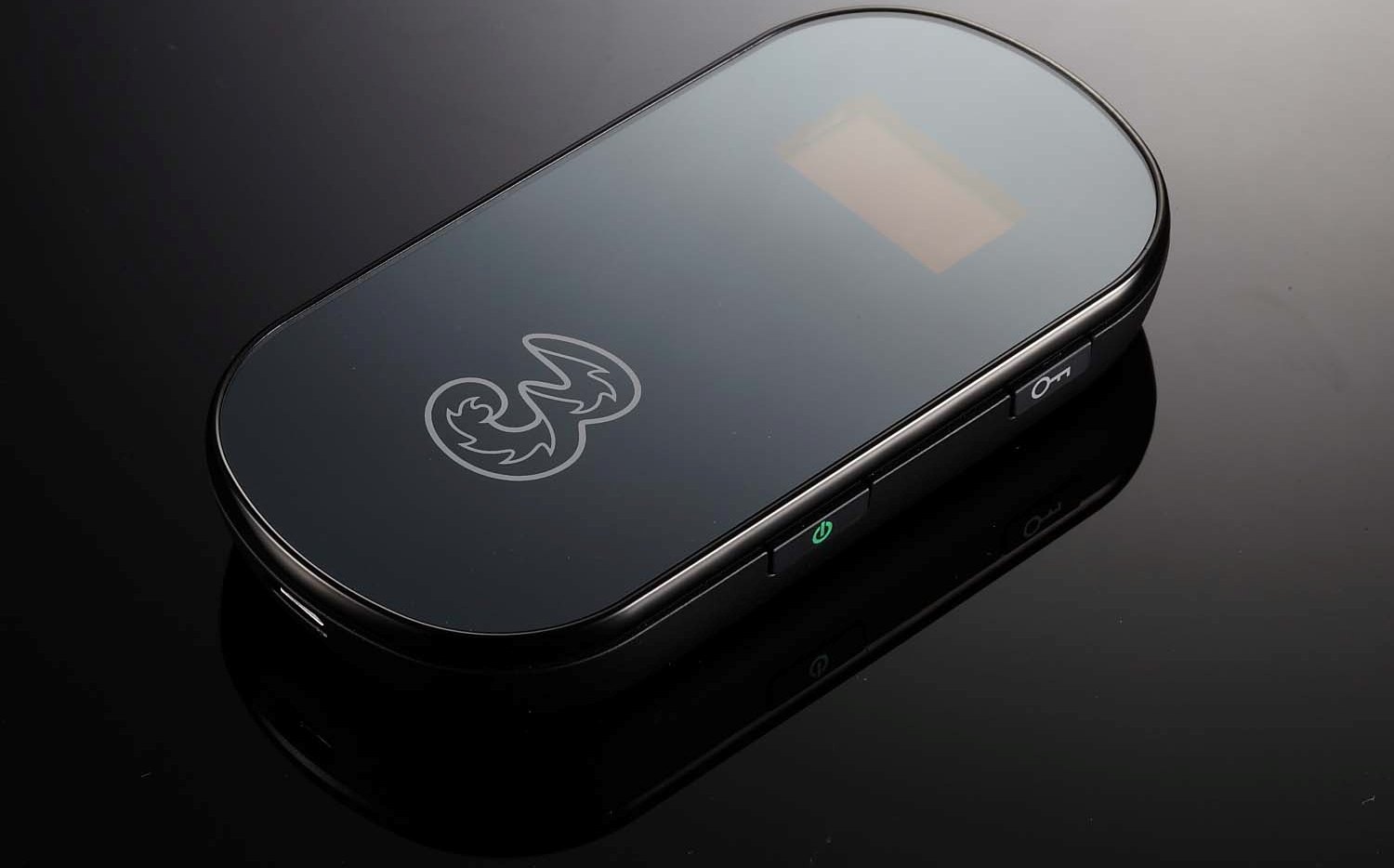
So what does the 586 offer that the 585 doesn’t? The introduction of a new charging cradle and minor design tweaks aside, the main difference is that this updated versions is an HSPA+ modem, which it claims will offer up to 21.1 Mbps download speeds. But the catch is, there’s a good chance you won’t be able to access anywhere near these sorts of speeds yet.
Three is rolling out HSPA+ to its networks during this year, and it aims to have 80% of its network upgraded to HSPA+ by the end of this year, with the rest following soon afterwards.
The typical use case of the MiFi dongle could include anything – you simply slip it in your pocket or rucksack and you have your very own Internet hotspot wherever you roam. I decided to test this baby out on a rail journey from Edinburgh to London, charting its performance on the way to see what types of speed I could get from it, after all, it’s all about speed…right?
The Edinburgh to London MiFi rail-test

Rolling out of Edinburgh Waverley train station at 14:50 on a Sunday afternoon, I did the first download/upload speed test, securing 2688/650 Kbps. At this speed, I could quite easily browse the Internet, watch YouTube clips and stream football commentary from BBC Radio. The occasional ‘buffer’ aside, it worked pretty seamlessly for about 30 minutes.
Ambling through the Scottish countryside an hour south of Edinburgh, the reception was very sporadic, shifting effortlessly between no reception at all and pretty fast. And it’s important to stress that this device has the same limitations that exist with a standard mobile phone connection on Three – so if you’re on the move, signal black-spots and tunnels will affect your ability to connect.
I recorded the following download/upload speeds at various intervals throughout the journey:
- 15:15: 312/208
- 15:20: 1952/1064
- 15:30: 2688/650
- 16:08: 2608/510
- 17:45: No network
- 19:43: 4144/362
- 19:50: 2504/554
The rail-test verdict
If I’m being honest, I found the intermittent promise of pretty fast mobile Internet rather frustrating. It peaked at around 4 Mbps, a speed which is more than adequate to do most things I’d need to do on the Web. But as soon as I was getting comfortable doing something, such as watching an online video or even simply reading an article, the connection would cut out. I would’ve been much better just busting out a book and reading rather than persevering with an Internet connection that was so inconsistent.Other scenarios
Okay, a rail-test that encompasses barren, hill-laden countryside isn’t perhaps the fairest of tests to properly assess the WiFi device, though if nothing else it helps to highlight what many rural locations have to put up with on a regular basis.Many people will simply want to be able to connect whilst traversing across a city. So, I tested this out at various times and locations in London. The typical download/upload speed lingered around the 1500/1000 Kbps mark. And whilst writing this piece, at home on a Saturday afternoon in London, the fastest I managed to secure was 1968/591 Kbps, but at times it dropped to half that in the space of a few minutes. So, the MiFi device is fast enough to use in a city perhaps, but probably couldn’t be used as someone’s main Internet source unless all they really needed was email and basic Web-browsing capabilities.
The potential for MiFi devices is huge, simply because people want high speed Internet access on the move, without worrying about whether the hotel or cafe they’re going to has free public WiFi or not. I think we’re getting there slowly, but from this test there’s clearly some way to go before we can expect to have fast, reliable Internet access wherever we roam.
http://thenextweb.com
It’s not sexy but it sure is popular: Group scheduling tool Doodle hits 10m monthly users

Doodle doesn’t have the most glamorous or sexy of products, and it rarely gets much press coverage, but the Swiss startup is clearly doing something right as it’s announced this week that it has hit the 10 million monthly user mark.
In case Doodle’s passed you by, it’s a tool that makes it easy for groups to arrange a mutually convenient time to meet. The meeting organiser proposes timeslots and everyone else votes for the slots that suit them. Earlier this year the company launched profile pages that make it easy to arrange one-to-one meetings too.
What’s interesting about Doodle is that I’ve never seen a tech-savvy early-adopting person use it. Instead, from personal experience it’s a product that ‘normal people’ use just to get a simple but important job done. It’s grown a huge audience without much of the Internet tech industry taking much notice.
The five year old startup says it has seen rapid growth in the past two years. Its total number of users is more than three times larger than it was in 2009, and in the US it now has 2 million users – almost four times more than it had two years ago. The company puts its growth down to the viral nature of the product – use it to arrange a meeting with ten other people and that’s ten more people who are introduced to it without having to sign up. In fact, Doodle says that 98% of all users discovered it from a personal invitation or recommendation.
http://thenextweb.com
No Email Day wants you to quit your inbox for 24 hours

As we reported last week, email is forty years old
this month, and despite plenty of challenges from rival forms of
messaging, it’s alive, well and still growing. It seems that many of us
suffer email overload, so wouldn’t it be good to take a day off? That’s
what the organiser of a new ‘No Email Day‘ hopes to persuade us to do.
No Email Day is a campaign that is encouraging people to stop using email completely for twenty-four hours on 11 November 2011 and do something more productive with the time they save instead. Organised by UK-based Paul Lancaster, the idea sprang from his constant, futile fight to reach ‘Inbox Zero‘.
So, how will No Email Day work? Lancaster explains:
I’d certainly be tempted to give up email for a day, although the following day I’d look all those unread messages in my inbox, feel bad about deleting them and start replying, one by one…
http://thenextweb.com
No Email Day is a campaign that is encouraging people to stop using email completely for twenty-four hours on 11 November 2011 and do something more productive with the time they save instead. Organised by UK-based Paul Lancaster, the idea sprang from his constant, futile fight to reach ‘Inbox Zero‘.
So, how will No Email Day work? Lancaster explains:
“This would involve switching off your email completely (or simply ignoring it) so you can focus completely on your ‘real work’ or ‘art’ that is currently going undone.The idea of avoiding email for a day may sound tempting for some, but wouldn’t that make life difficult in the workplace? Lancaster believes that the role of office email is overrated.
“If you do need to contact someone on this day, emails should be strictly off limits – replaced instead by real life, face to face interaction, picking up the phone or perhaps even writing a letter (remember those?) Better still if you can spend time away from work to be inspired and re-connect with the offline world.”
“How did people survive and get work done in the past? Could we be even more productive in the workplace without the distractions of email? Admittedly, some would still need their own emails to do their job but many of us could get by with a shared inbox that we all used to send and receive work-related emails.”So, will you give up email for a day on 11 November? The campaign is centered around its Facebook page, and you can find more information in this presentation. With only 64 Facebook likes at the time of writing, it’s only just getting off the ground, although amongst those ‘likers’ is Seth Godin, the influential marketing expert.
I’d certainly be tempted to give up email for a day, although the following day I’d look all those unread messages in my inbox, feel bad about deleting them and start replying, one by one…
http://thenextweb.com
William Gibson Interview

Illo: Rob Beschizza. Photo: Frederic Poirot
Author William Gibson discusses Victorians, John Shirley and the
early days of his career. A longer version of this interview appeared in
the 197th issue of Paris Review
INTERVIEWER
Do you think fiction should be predictive?GIBSON
No, I don’t. Or not particularly. The record of futurism in science fiction is actually quite shabby, it seems to me. Used bookstores are full of visionary texts we’ve never heard of, usually for perfectly good reasons.INTERVIEWER
You’ve written that science fiction is never about the future, that it is always instead a treatment of the present.GIBSON
There are dedicated futurists who feel very seriously that they are extrapolating a future history. My position is that you can’t do that without having the present to stand on. Nobody can know the real future. And novels set in imaginary futures are necessarily about the moment in which they are written. As soon as a work is complete, it will begin to acquire a patina of anachronism. I know that from the moment I add the final period, the text is moving steadily forward into the real future.There was an effort in the seventies to lose the usage science fiction and champion speculative fiction. Of course, all fiction is speculative, and all history, too—endlessly subject to revision. Particularly given all of the emerging technology today, in a hundred years the long span of human history will look fabulously different from the version we have now. If things go on the way they’re going, and technology keeps emerging, we’ll eventually have a near-total sorting of humanity’s attic.
In my lifetime I’ve been able to watch completely different narratives of history emerge. The history now of what World War II was about and how it actually took place is radically different from the history I was taught in elementary school. If you read the Victorians writing about themselves, they’re describing something that never existed. The Victorians didn’t think of themselves as sexually repressed, and they didn’t think of themselves as racist. They didn’t think of themselves as colonialists. They thought of themselves as the crown of creation.
Of course, we might be Victorians, too.
INTERVIEWER
The Victorians invented science fiction.GIBSON
I think the popular perception that we’re a lot like the Victorians is in large part correct. One way is that we’re all constantly in a state of ongoing technoshock, without really being aware of it—it’s just become where we live. The Victorians were the first people to experience that, and I think it made them crazy in new ways. We’re still riding that wave of craziness. We’ve gotten so used to emergent technologies that we get anxious if we haven’t had one in a while.But if you read the accounts of people who rode steam trains for the first time, for instance, they went a little crazy. They’d traveled fifteen miles an hour, and when they were writing the accounts afterward they struggled to describe that unthinkable speed and what this linear velocity does to a perspective as you’re looking forward. There was even a Victorian medical complaint called “railway spine.”
Emergent technologies were irreversibly altering their landscape. Bleak House is a quintessential Victorian text, but it is also probably the best steam-punk landscape that will ever be. Dickens really nailed it, especially in those proto-Ballardian passages in which everything in nature has been damaged by heavy industry. But there were relatively few voices like Dickens then. Most people thought the progress of industry was all very exciting. Only a few were saying, Hang on, we think the birds are dying.
++++++++++++++++++
INTERVIEWER
You wrote your first story for a class, didn’t you?GIBSON
A woman named Susan Wood had come to UBC as an assistant professor. We were the same age, and I met her while reconnoitering the local science-fiction culture. In my final year she was teaching a science-fiction course. I had become really lazy and thought, I won’t have to read anything if I take her course. No matter what she assigns, I’ve read all the stuff. I’ll just turn up and bullshit brilliantly, and she’ll give me a mark just for doing that. But when I said, “Well, you know, we know one another. Do I really have to write you a paper for this class?” She said, “No, but I think you should write a short story and give me that instead.” I think she probably saw through whatever cover I had erected over my secret plan to become a science-fiction writer.I went ahead and did it, but it was incredibly painful. It was the hardest thing I did in my senior year, writing this little short story. She said, “That’s good. You should sell it now.” And I said, “No.” And she said, “Yeah, you should sell it.” I went and found the most obscure magazine that paid the least amount of money. It was called Unearth. I submitted it to them, and they bought it and gave me twenty-seven dollars. I felt an enormous sense of relief. At least nobody will ever see it, I thought. That was “Fragments of a Hologram Rose.”
INTERVIEWER
How did you meet John Shirley?GIBSON
Shirley was the only one of us who was seriously punk. I’d gone to a science-fiction convention in Vancouver, and there I encountered this eccentrically dressed young man my age who seemed to be wearing prison pajamas. He was an extremely outgoing person, and he introduced himself to me: “I’m a singer in a punk band, but my day job is writing science fiction.” I said, “You know, I write a little science fiction myself.” And he said, “Published anything?” And I said, “Oh, not really. This one story in this utterly obscure magazine.” He said, “Well, send me some of your stuff, I’ll give you a critique.”As soon as he got home he sent me a draft of a short story he had written perhaps an hour beforehand: “This is my new genius short story.” I read it—it was about someone who discovers there are things that live in bars, things that look like drunks and prostitutes but are actually something else—and I saw, as I thought at the time, its flaws. I sat down to write him a critique, but it would have been so much work to critique it that instead I took his story and rewrote it. It was really quick and painless. I sent it back to him, saying, “I hope this won’t piss you off, but it was actually much easier for me to rewrite this than to do a critique.” The next thing I get back is a note—“I sold it!” He had sold it to this hardcover horror anthology. I was like, Oh, shit. Now my name is on this weird story.
People kept doing that to me, and it’s really good that they did. I’d give various friends stuff to read, and they’d say, “What are you going to do with this?” And I’d say, “Nothing, it’s not nearly there yet.” Then they’d Xerox it and submit it on my behalf, to places I would have been terrified to submit to. It seemed unseemly to me to force this unfinished stuff on the world at large.
INTERVIEWER
Do you still consider that work unfinished?GIBSON
I had a very limited tool kit when I began writing. I didn’t know how to handle transitions, so I used abrupt breaks, the literary equivalent of jump cuts. I didn’t have any sense of how to pace anything. But I had read and ad- mired Ballard and Burroughs, and I thought of them as very powerful effect pedals. You get to a certain place in the story and you just step on the Ballard.INTERVIEWER
What was the effect?GIBSON
A more genuine kind of future shock. I wanted the reader to feel constantly somewhat disoriented and in a foreign place, because I assumed that to be the highest pleasure in reading stories set in imaginary futures. But I’d also read novels where the future-weirdness quotient overwhelmed me and simply became boring, so I tried to make sure my early fiction worked as relatively solid genre pieces. Which I still believe is harder to do. When I started Neuromancer, for instance, I wanted to have an absolutely familiar, utterly well-worn armature of pulp plot running throughout the whole thing. It’s the caper plot that carries the reader through.INTERVIEWER
What do you think of Neuromancer today?GIBSON
When I look at Neuromancer I see a Soap Box Derby car. I felt, writing it, like I had two-by-fours and an old bicycle wheel and I’m supposed to build something that will catch a Ferrari. This is not going to fly, I thought. But I tried to do it anyway, and I produced this garage artifact, which, amazingly, is still running to this day.Even so, I got to the end of it, and I didn’t care what it meant, I didn’t even know if it made any sense as a narrative. I didn’t have this huge feeling of, Wow, I just wrote a novel! I didn’t think it might win an award. I just thought, Phew! Now I can figure out how to write an actual novel.
http://boingboing.net
Breaking His Promise To Create 700K Jobs, Gov. Rick Scott Now Says ‘I Don’t Have To Create Any Jobs’
 Gov.
Rick Scott (R-FL) campaigned on a promise to create jobs in Florida —
his campaign mantras were even “Let’s get to work!” and “jobs, jobs,
jobs.” However, recently he’s backed off
his earlier pledge to create 700,000 jobs in addition to the 1 million
jobs Florida is expected to generate as part of the state’s natural
growth, absurdly claiming “I don’t know who said that.”
Gov.
Rick Scott (R-FL) campaigned on a promise to create jobs in Florida —
his campaign mantras were even “Let’s get to work!” and “jobs, jobs,
jobs.” However, recently he’s backed off
his earlier pledge to create 700,000 jobs in addition to the 1 million
jobs Florida is expected to generate as part of the state’s natural
growth, absurdly claiming “I don’t know who said that.”Now the St. Petersburg Times is reporting that Scott is scaling back his promises even further, claiming, “I could argue that I don’t have to create any jobs”:
Gov. Rick Scott on Thursday added more nuance to his campaign promise to create jobs, questioning the validity of the state’s economic forecast and saying he just has to stop unemployment from rising.Florida has a 10.7 percent unemployment rate that is higher than the national average. Yet Scott recently bragged about laying off 15,000 government workers, while deep education cuts will cost many teachers and school employees their jobs. Scott also rejected $2.4 billion in federal money for a high-speed rail project that supporters say would have created 24,000 jobs.
“The bottom line is, I could argue that I don’t have to create any jobs,” Scott said on 540-AM in Maitland. “I just have to make sure we don’t lose jobs.“
Putting ideology over the welfare of Floridians, Scott has also indicated that he will reject the billions in federal aid that could flow to the state under President Obama’s jobs act. The state is slated to receive more than $7.5 billion for schools, roads and other projects under the American Jobs Act. The White House estimates that the funds under the plan would support more than 60,000 jobs in Florida, including those held by teachers, cops, and firefighters.
http://thinkprogress.org
Report: 25 Percent Of Millionaires Pay Lower Taxes Than 10.4 Million Middle-Class Americans
 President Obama’s “Buffett Rule”
is aimed at ensuring that wealthy Americans pay their fair share in
taxes. As it stands today, a wealthy individual can take advantage of
preferential tax treatment of investment income and various tax
loopholes to drastically lower his or her tax rate and effectively pay
lower taxes than middle-class families. To prove the point behind his
namesake, billionaire Warren Buffett revealed to Republicans yesterday
that he made more than $62 million last year while only paying a 17 percent tax rate.
President Obama’s “Buffett Rule”
is aimed at ensuring that wealthy Americans pay their fair share in
taxes. As it stands today, a wealthy individual can take advantage of
preferential tax treatment of investment income and various tax
loopholes to drastically lower his or her tax rate and effectively pay
lower taxes than middle-class families. To prove the point behind his
namesake, billionaire Warren Buffett revealed to Republicans yesterday
that he made more than $62 million last year while only paying a 17 percent tax rate. It is not surprising that Republicans like GOP candidate Mitt Romney who slam the Buffett Rule as “class warfare” simultaneously benefit from the same sort of preferential treatment. In fact, a new report by the non-partisan Congressional Research Service finds that 25 percent of the nation’s millionaires have a lower effective tax rate than 10.4 million middle-class Americans:
About 25 percent of millionaires in the U.S. pay federal taxes at lower effective rates than a significant portion of middle-income taxpayers, according to a legislative analysis.In direct conflict with a favorite Republican talking point, the report also found that very few business owners are millionaires and “played down the impact of higher tax rates on job creation.” “The small share of taxpayers with small-business income in the millionaire category suggests that tax reform policies designed to ensure adherence to the Buffett Rule will affect few small businesses,” it said. This bolsters the claims from economists and business owners alike that higher tax rates on the rich make “zero difference” in hiring.
Preferential treatment of investment income and the reduced impact of payroll taxes on high earners lets about 94,500 millionaires pay taxes at a lower rate than 10.4 million “moderate-income taxpayers,” representing about 10 percent of those making less than $100,000 a year, according to the report by the non-partisan Congressional Research Service dated Oct. 7.
Numerous polls continually show that Americans support raising the tax rate on millionaires. But rather than raise the rates on those who should pay their fair share, Republicans respond with even more tax increases on the middle class. “Class warfare,” indeed.
http://thinkprogress.org
Kaydol:
Kayıtlar (Atom)